
A clearer path from practice to progress.
Pinpoint Academy is a small Primary Mathematics academy at The Woodleigh Mall. We teach in groups of eight, look closely at the work each student actually produces, and tell you plainly what is secure and what still needs attention.
“My child practises, but I don’t really know where the gaps are.”
- Levels
- Primary 3, 4 and 5 · Mathematics
- Weekly lesson
- 2 hours, in person
- Class size
- 8 students maximum
- Precision Session
- 1 hour · 3 students maximum
- Taught by
- The founding team
- Where
- The Woodleigh Mall, #02-10
Class timings are confirmed at enquiry, by level.
Directions to the centrePractice is easy to see. Understanding is not.
A student can finish every worksheet, attend every lesson and still lose the same marks each term. The completed work says the practice happened. It does not say which step broke down, or whether the next topic is going to sit on top of a gap.
So we start from the work itself. Every lesson produces something we can read — a diagnostic, in-class accuracy, an Exit Check, the homework. Read together, they point to a specific skill rather than a vague subject-level worry, and that specific skill is what a Precision Session is for.
Clearer visibility. Targeted support.
Stronger progress.
How a weak skill gets noticed, named and closed.
The Progress Path is the sequence every student’s week runs through. It is one part of the academy — the part that makes sure a difficulty is caught while it is still small.
- Step 1
Practice
Guided and independent work in every weekly lesson.
- Step 2
Performance Visibility
That work is read topic by topic, not just marked.
- Step 3
Pinpoint
One specific weak skill or misconception is named.
- Step 4
Precision Sessions
An hour with at most three students, on that skill.
- Step 5
Progress
The same skill is re-checked, and the change is recorded.
Three topics · one term of evidence
Word Problems · choosing the method
Eight in the class · three in the session
Re-checked · the change is recorded
A plain reading of where each student stands.
Not a score out of a hundred, and not a grade. A topic-by-topic read of what is secure, what is wobbling, and what we intend to do about it next.
Handles standard fraction operations confidently.
Continue practice.
Makes errors in comparison model questions.
Monitor next lesson.
Struggles to identify the correct method.
Precision Session recommended.
Three topics · one term of evidence
Word Problems · choosing the method
Eight in the class · three in the session
Re-checked · the change is recorded
From a term of evidence to one named skill.
Read together, the week’s evidence stops being a general worry about word problems and becomes something specific: choosing the method. That is the thing we act on, and it is the thing we tell you about.
- Diagnostic score
- In-class accuracy
- Exit Check score
- Homework completion
- A weak-topic note, where one is needed
- Strength
- What went well, in the teacher’s own words.
- Concern
- The specific thing that is not yet holding.
- Next step
- What we will do about it in the coming week.
The platform supports the teacher. It does not replace the teacher.
Three topics · one term of evidence
Word Problems · choosing the method
Eight in the class · three in the session
Re-checked · the change is recorded
When one skill is the problem, eight is still too many.
A weekly class of eight is small enough to teach well. It is not small enough to sit with one student through the exact step they keep getting wrong. That is a different session, and we run it separately.
- One hour, focused on a single skill or misconception.
- Capped at three students, so nobody can sit quietly at the back.
- One credit each month. Credits are issued monthly and do not roll over.
- Recommended from lesson evidence and the teacher’s own observations.
- Tracked separately from regular lesson credits.
- Not general homework help, and not extra tuition for its own sake.
Three topics · one term of evidence
Word Problems · choosing the method
Eight in the class · three in the session
Re-checked · the change is recorded
The same skill, checked again.
A Precision Session is not the end of it. The same skill comes back in a later lesson — in practice, in an Exit Check, in the next piece of homework — and what happens then is recorded against the same topic.
Sometimes it has held. Sometimes it needs another pass. Either way you are told which, and the picture you are given is the one the teacher is actually working from.
That is the whole loop: practise, look, name it, work on it, look again.
Two hours, run to the same eight-part sequence.
Every regular lesson follows this run sheet. It is why the same things get checked every week, and why a difficulty shows up in the record rather than only in a teacher’s memory.
- Length
- 2 hours
- Class cap
- 8 students
- Taught by
- The founding team
- 01ReviewWhat is still holding from last week, and what has slipped.
- 02DiagnoseA short check that shows who is ready for the new topic.
- 03TeachThe concept, explained to the group in front of us.
- 04PractiseGuided then independent work, with the teacher circulating.
- 05Review MistakesErrors are opened up in class rather than only marked.
- 06Exit CheckA short close that records what each student left with.
- 07ChallengeDeeper application for students who are ready for it.
- 08Follow UpHomework, a teacher note, and anything to raise with you.
The work students take home.
Every student works from a Learning Dossier written for that week’s topic — the concept, worked examples, practice, and the page where the lesson’s evidence is recorded. These are real pages from a Primary 4 dossier.
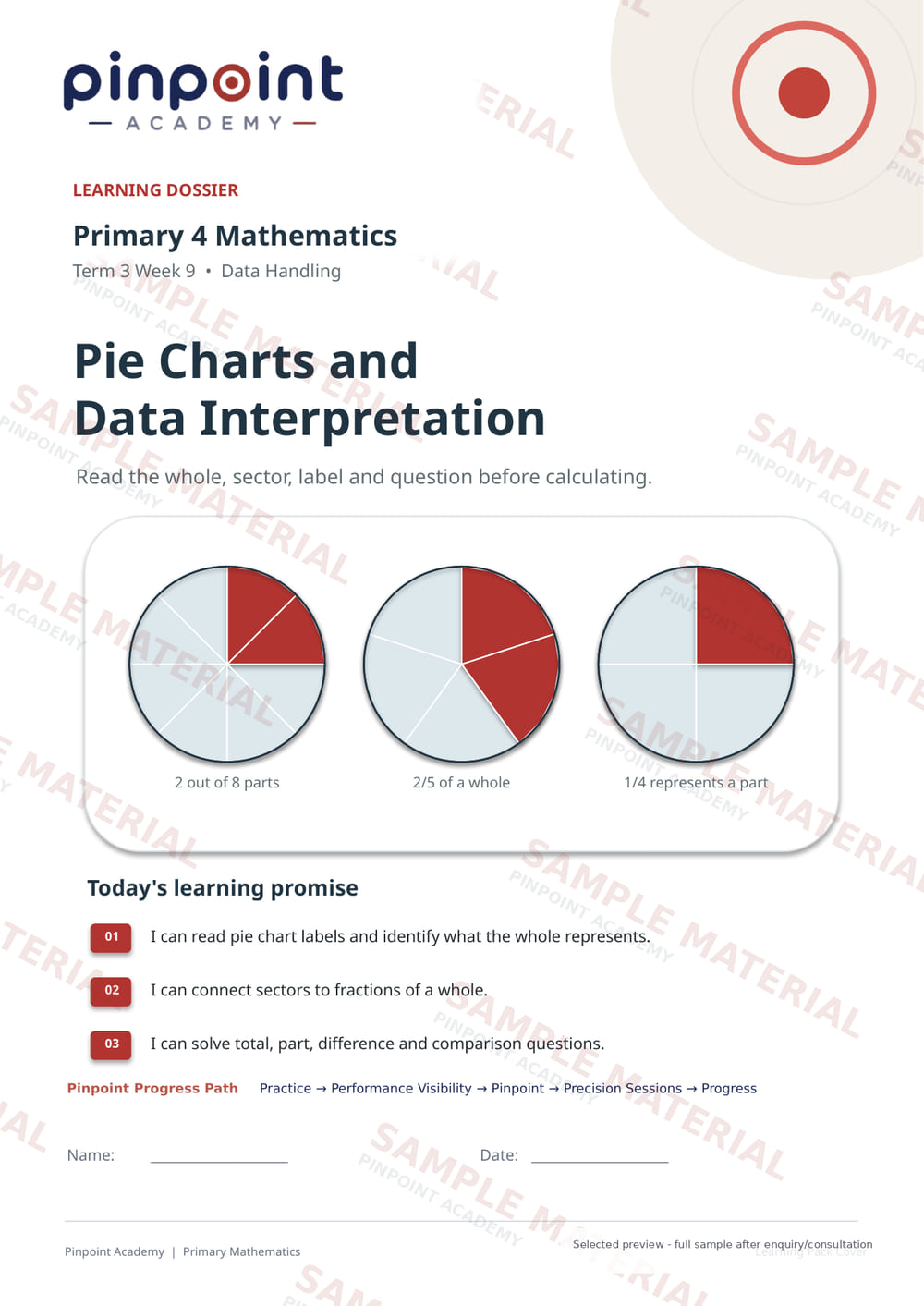
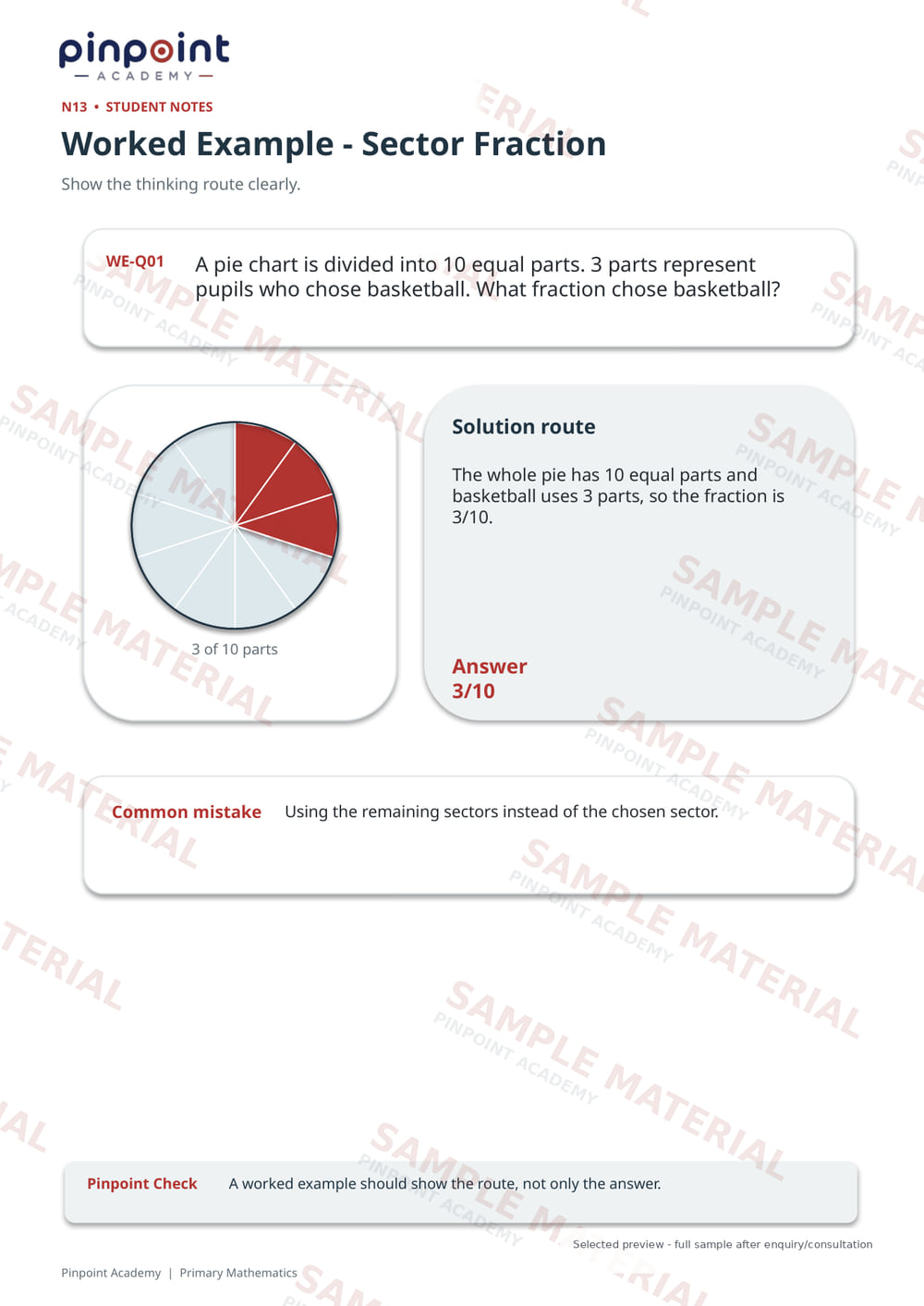
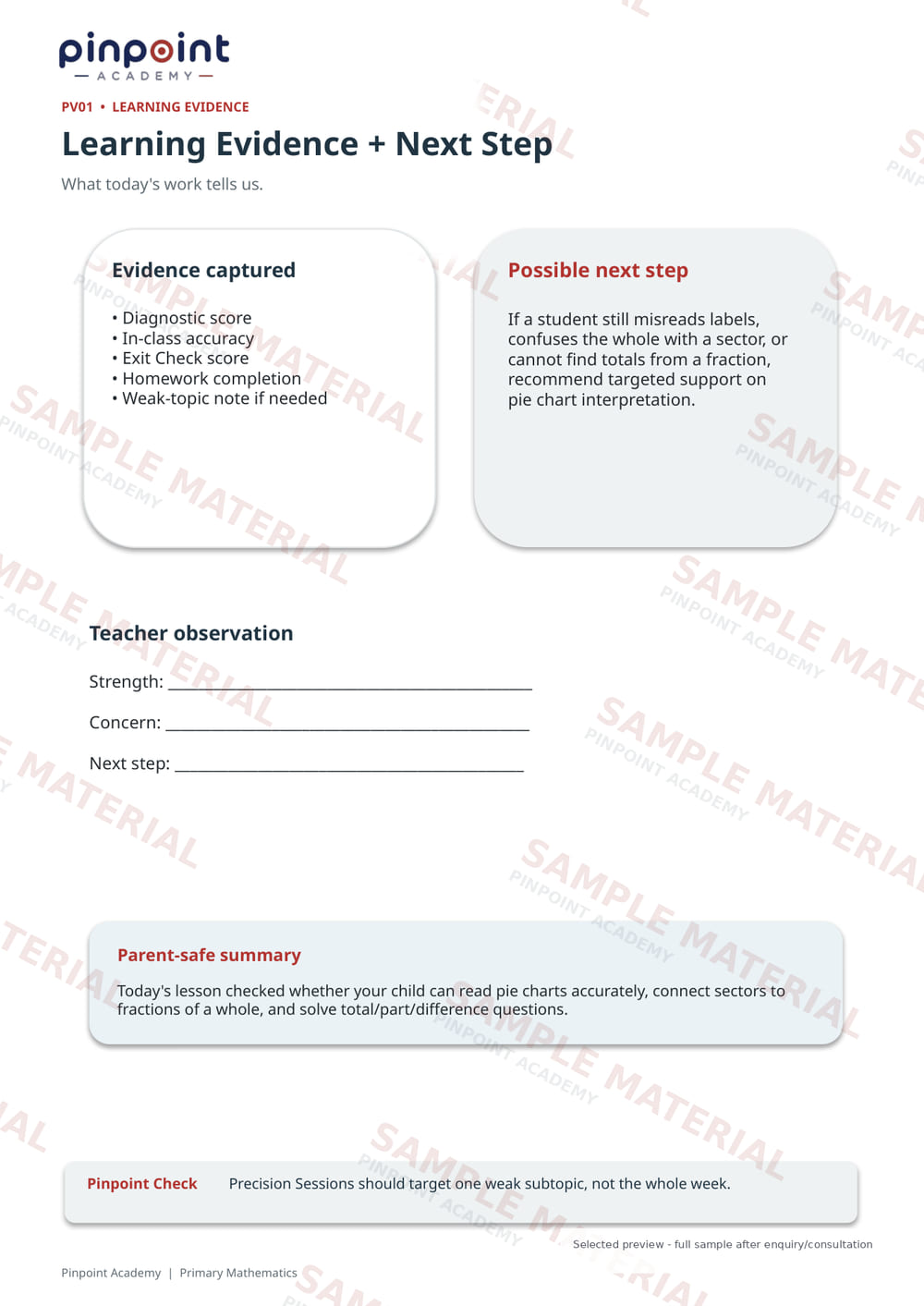
Selected pages only. The full sample is shared at enquiry or during a parent consultation.
The people who actually teach the classes.
Pinpoint Academy is new and deliberately small. The current Primary 3–5 Mathematics intake is taught and overseen directly by the three of us — teaching, materials, progress and the conversations with parents.

Ng Ean
Founder & Head of Academy
Leads the academy’s direction, the learning system, the programme model and how student progress is tracked.
- Best in Mathematics, Nan Hua Primary — P3 and P5
- NUS High School of Math and Science graduate

Ng Chye Ming
Director & Co-founder
Oversees academy operations, the parent experience and long-term development, so the academy is built carefully and sustainably.
- 20 years of senior managerial experience in multinational companies
- Experience managing children’s educational enrichment centres

Lye Wai Ping
Founding Advisor & Head of Curriculum
Leads curriculum direction, reviews the learning materials and shapes how concepts are explained, practised and reinforced.
- First Class Honours, NUS Bachelor of Engineering (Chemical)
- Dean’s List recipient for 6 semesters
- Experience managing children’s educational enrichment centres
Why I started Pinpoint
Ng Ean
Founder & Head of Academy
I founded Pinpoint Academy at 20, around a way of learning I worked out as a student myself. Real progress never came from doing more questions. It came from practising with a purpose, understanding where the mistakes were actually happening, getting focused help on those specific things, and then being able to see the improvement.
That is what the Pinpoint Progress Path is: Practice, Performance Visibility, Pinpoint, Precision Sessions, Progress. I want students to have the clarity and the support I think every learner deserves — and I want families to be able to see that journey, rather than guess at it.
One programme, one fee, stated plainly.
On a S$90 per 2-hour lesson basis.
- Weekly 2-hour small-group Mathematics lessons
- Classes capped at 8 students
- Learning Dossier and programme materials
- The Pinpoint Progress Path
- Topic-by-topic progress visibility
- Teacher observations and follow-up
- 1 Precision Session credit each month
- Parent-platform access
- Credit-based regular lesson usage
- 01
A free trial class
The student joins a real regular lesson while you meet the founding team and we talk through whether the programme is a fit.
- 02
Starter Month — S$250
Four 2-hour regular lessons, with everything the regular programme includes, before you decide about continuing.
- 03
Regular programme — S$360/month
Weekly lessons, progress visibility and a monthly Precision Session credit.
If a student cannot attend a lesson
We will first try to arrange a suitable replacement lesson, subject to availability. If no suitable replacement can be arranged, the regular lesson credit will not be used.
Regular lesson credits and Precision Session credits are tracked separately. Precision Session credits are issued monthly and do not roll over.
The programme may suit students who
- Need targeted help with particular topics
- Benefit from clearer explanations and structure
- Are strengthening foundations and confidence
- Are ready for deeper application and greater challenge
- Come from families who want clearer progress visibility
One centre, at The Woodleigh Mall.
11 Bidadari Park Drive, #02-10
- Held within
- SAA, at The Woodleigh Mall
- Format
- In person, small group
- Class timings
- Shared at enquiry, by level
Questions parents ask us.
If your question is not here, ask us directly — we would rather tell you the programme is not a fit than have you find out in month two.
Ask us on WhatsAppStart with one real lesson.
The enquiry takes about a minute. The student sits in on a regular lesson, you meet the founding team, and we tell you honestly whether the programme is right for them.
- +65 9651 1424
- Centre
- The Woodleigh Mall, 11 Bidadari Park Drive, #02-10 · within SAA